
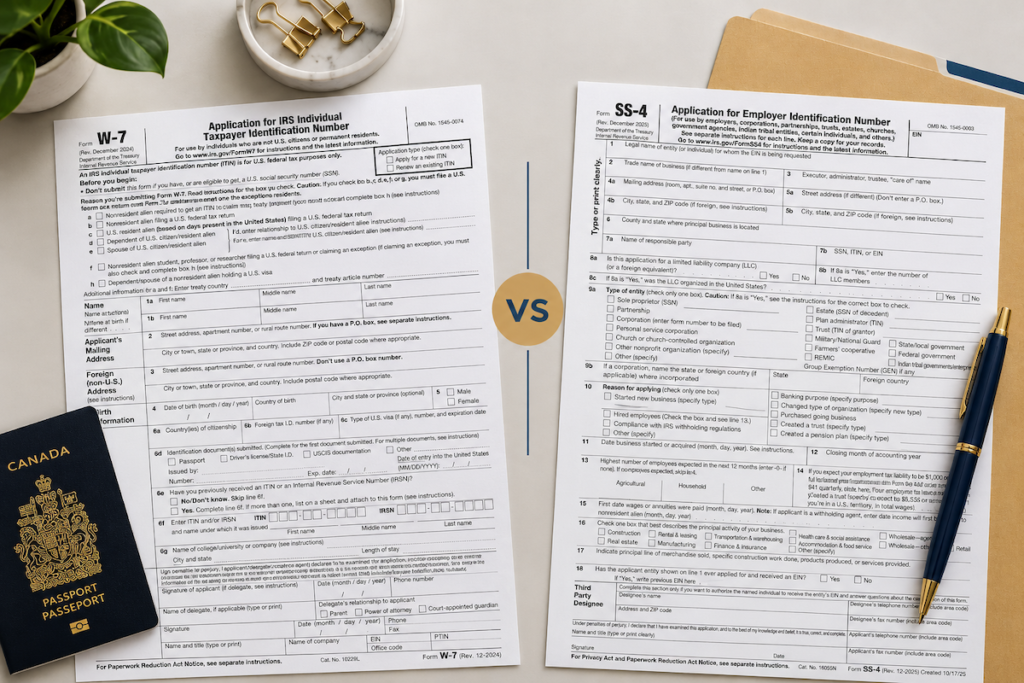

If you’re a foreign individual earning income from the United States or looking to start a U.S. business, you’ve probably come across two different tax identification numbers: the Individual Taxpayer Identification Number (ITIN) and the Employer Identification Number (EIN).
Both are issued by the Internal Revenue Service (IRS), both consist of nine digits, and both are used for U.S. tax purposes. However, they serve very different functions.
The short answer is that an ITIN identifies an individual for tax purposes, while an EIN generally identifies a business or other entity. Depending on your circumstances, you might need one, both, or neither.
Let’s break down the differences and help you determine which applies to your situation.
ITIN vs. EIN: Key Differences at a Glance
| Feature | ITIN | EIN |
|---|---|---|
| Full name | Individual Taxpayer Identification Number | Employer Identification Number |
| Issued to | Individuals | Businesses and other entities, including some individuals |
| Primary purpose | Individual U.S. federal tax reporting | Business and entity tax identification |
| Number format | 9XX-XX-XXXX | XX-XXXXXXX |
| IRS application form | W-7 | SS-4 |
| Application fee | Free from the IRS | Free from the IRS |
| Expiration | Can expire after prolonged nonuse | Generally does not expire |
While both are considered Taxpayer Identification Numbers (TINs), they are not interchangeable.
What is an ITIN?
An Individual Taxpayer Identification Number (ITIN) is a nine-digit number issued by the IRS to individuals who need a U.S. taxpayer identification number for federal tax purposes but are not eligible to receive a Social Security Number (SSN).
ITINs are commonly issued to nonresident aliens, including Canadians and other foreign nationals who have U.S. tax reporting obligations.
For example, you might need an ITIN if you:
- Are a nonresident required to file a U.S. federal income tax return.
- Earn U.S. rental income or have other U.S. investments that create tax reporting obligations.
- Need to claim certain benefits under a U.S. income tax treaty.
- Are the spouse or dependent of a U.S. taxpayer and require a tax identification number for an allowable tax benefit.
An ITIN can also be useful for accessing certain U.S. financial products, such as bank accounts and credit cards, although eligibility varies by institution.
Importantly, an ITIN does not provide U.S. immigration status or authorization to work in the United States.
Read more: Guide to the Individual Taxpayer Identification Number (ITIN)
What is an EIN?
An Employer Identification Number (EIN), sometimes referred to as a Federal Employer Identification Number (FEIN), is a nine-digit number issued by the IRS to identify businesses and other entities for tax purposes.
Despite its name, you don’t need to have employees to require an EIN.
For example, U.S. corporations and partnerships generally require an EIN for federal tax reporting, as do certain Limited Liability Companies (LLCs). An EIN may also be needed for business banking, payroll, or other reporting requirements.
Foreign individuals can obtain EINs for qualifying U.S. business activities without being U.S. citizens or residents.
For a more detailed explanation, see our comprehensive guide to Employer Identification Numbers.
Do You Need an ITIN, an EIN, or Both?
The answer depends on whether you have personal U.S. tax obligations, business tax obligations, or both.
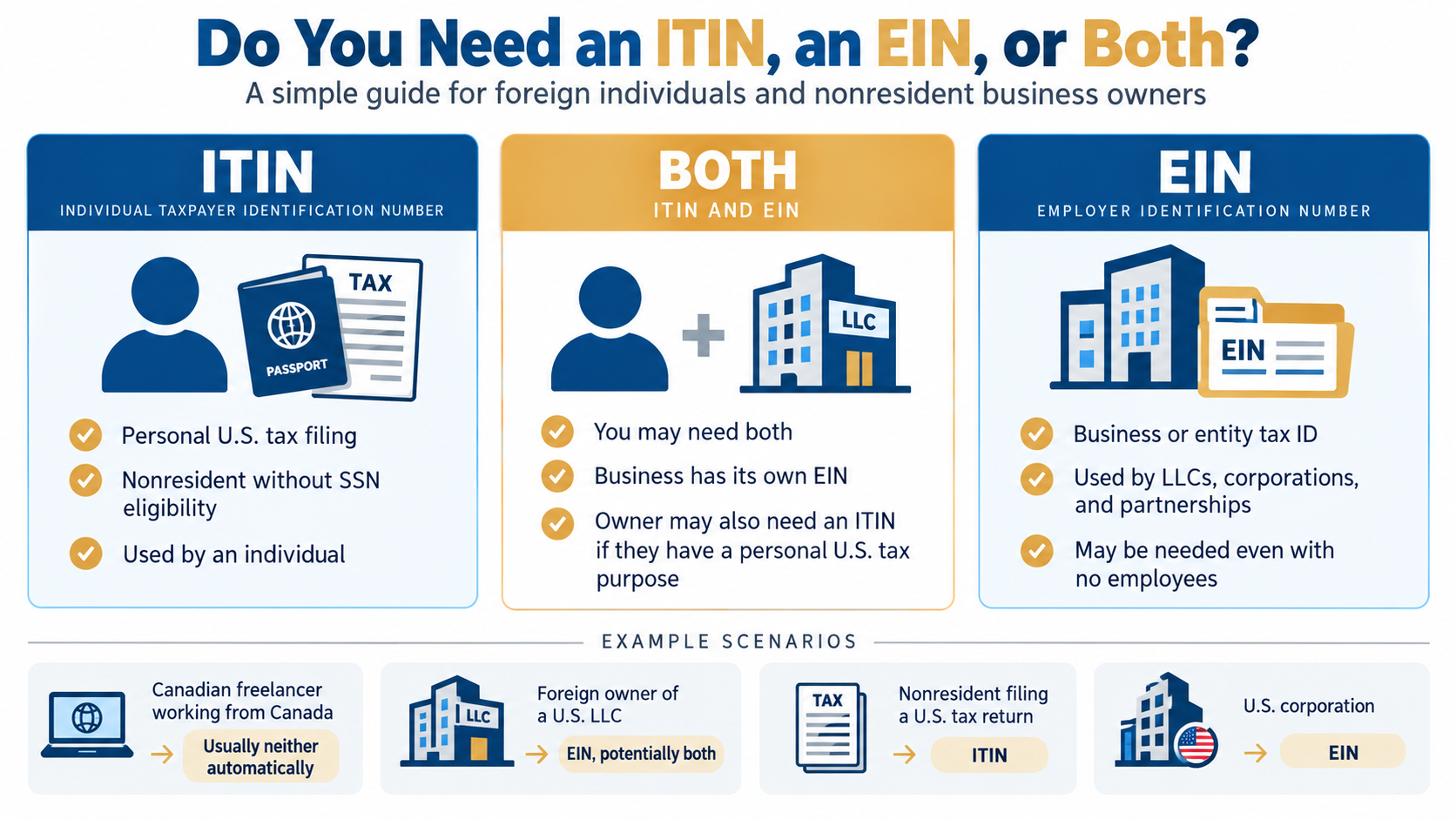
Below are some common scenarios.
| Your Situation | Tax ID You May Need | Explanation |
|---|---|---|
| Canadian freelancer working remotely from Canada for U.S. clients | Neither | Having American customers doesn’t automatically create U.S. tax obligations. |
| Nonresident filing a personal U.S. income tax return | ITIN | An ITIN is generally required if you’re ineligible for an SSN. |
| Canadian personally owning U.S. rental property | ITIN | Generally needed if you must file a personal U.S. tax return to report rental income or claim deductions. |
| Foreign individual who forms a single-member U.S. LLC | EIN, potentially both | The LLC may need an EIN for reporting purposes. The owner only needs an ITIN if they have a separate qualifying federal tax purpose. |
| Foreign owners of a U.S. multi-member LLC taxed as a partnership | EIN, potentially both | The partnership generally needs an EIN, while individual partners may need ITINs for their personal filing obligations. |
| Canadian who owns shares in a U.S. C corporation | EIN for the corporation | The corporation needs an EIN, but foreign shareholders don’t automatically need ITINs simply because they own shares. |
| Canadian investing in U.S. stocks through a brokerage | Usually neither | Form W-8BEN and a foreign tax identification number are generally sufficient for routine withholding purposes. |
These are general examples. Your actual requirements depend on factors including your U.S. tax residency, business structure, and whether you’re required to file a U.S. federal tax return.
Do Foreign Owners of U.S. LLCs Need Both an ITIN and EIN?
Let’s consider a common example: you’re a Canadian resident who establishes a single-member LLC in Wyoming to operate an online business.
Your LLC may need an EIN to satisfy IRS reporting requirements. For example, a foreign-owned U.S. disregarded entity generally must file Form 5472 with a pro forma Form 1120 when it has reportable transactions, which can include contributions of money from its foreign owner.
However, obtaining an EIN for your LLC doesn’t automatically mean you personally need an ITIN.
If you have no separate U.S. federal tax filing obligation or other qualifying tax purpose, you may not need an ITIN at all. Conversely, if your business activities create personal U.S. tax reporting obligations, you may require both numbers.
This distinction matters because a single-member LLC can be treated as a disregarded entity for federal income tax purposes, meaning its income and activities may be attributed directly to its owner.
In other words, the LLC’s tax identification requirements and your personal tax obligations are two separate questions.
Can You Get an EIN Without an ITIN or SSN?
Yes! You do not necessarily need an ITIN or SSN to obtain an EIN.
This is a common point of confusion for foreign business owners, particularly those applying from outside the United States.
IRS Form SS-4 asks for the responsible party’s SSN, ITIN, or EIN on line 7b. However, the official IRS instructions explicitly allow applicants to enter “foreign” or “N/A” if the responsible party does not have and is ineligible to obtain an SSN or ITIN.
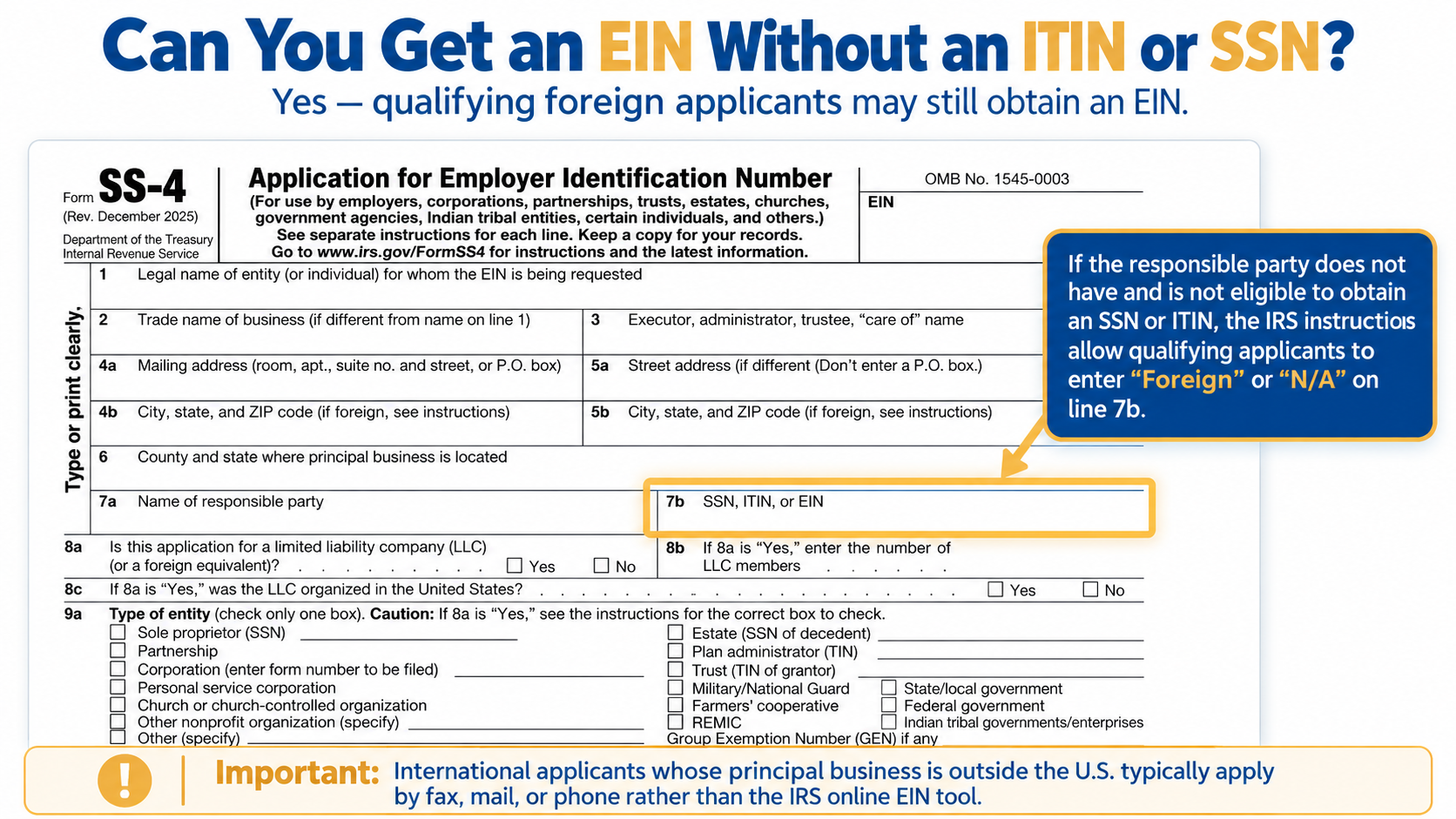
This means a qualifying foreign business owner can apply for an EIN without first obtaining a personal U.S. tax identification number.
There is one important limitation: the IRS online EIN application generally requires the principal place of business to be in the United States and a valid taxpayer identification number for the responsible party.
International applicants whose principal place of business is outside the U.S. can instead apply by telephone, fax, or mail.
How to Apply for an ITIN or EIN
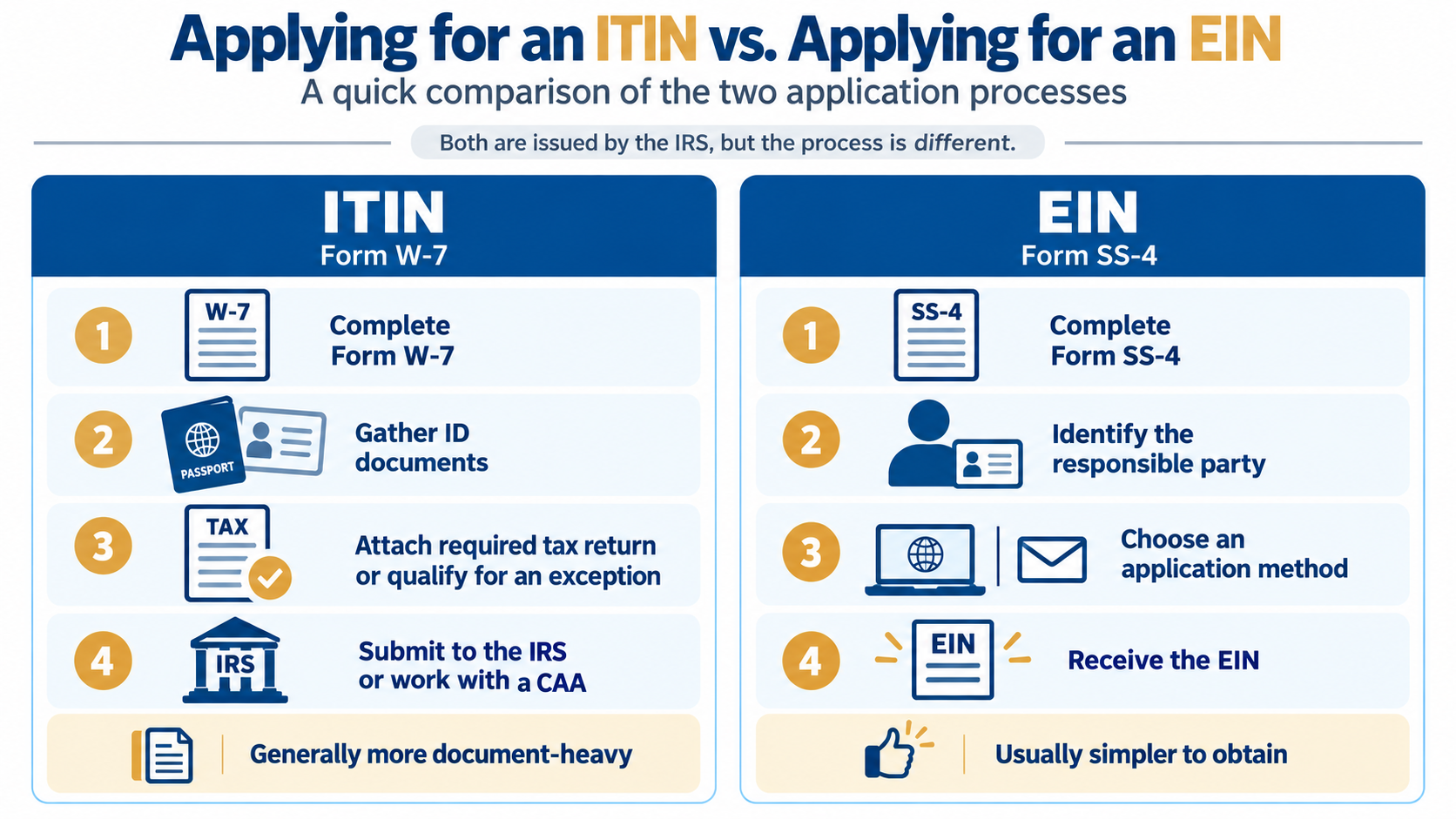
Although both numbers are issued by the IRS, their application processes are quite different.
Applying for an ITIN (Form W-7)
To apply for an ITIN, you’ll need to complete IRS Form W-7 and provide documentation establishing your identity and foreign status.
In most cases, you’ll also need to submit a U.S. federal income tax return, typically Form 1040-NR, unless you qualify for a specific IRS exception.
One of the more inconvenient requirements is providing original identification documents, such as your passport, or acceptable certified copies.
Alternatively, you can use an IRS-authorized Certifying Acceptance Agent (CAA) to verify eligible identification documents without mailing your original passport to the IRS.
At ITIN Genie, we help foreign applicants prepare their ITIN applications and offer document verification services so you can keep your passport at home.
Applying for an EIN (Form SS-4)
Obtaining an EIN is generally more straightforward.
Eligible applicants with a principal business location in the United States can apply online through the IRS and receive an EIN immediately upon successful completion.
International applicants can submit Form SS-4 by fax or mail, or apply by telephone if their principal business is located outside the United States.
There is no IRS fee to obtain an EIN, and the application does not require passport verification.
You can find the available methods and requirements on the IRS EIN application page.
ITIN vs. EIN: Frequently Asked Questions
Can You Use an EIN Instead of an ITIN to File Personal Taxes?
Generally, no. An EIN does not replace the need for an individual’s SSN or ITIN when filing a personal U.S. federal income tax return.
Even if you are the sole owner of a business with an EIN, you may still require a separate personal taxpayer identification number.
Do You Need an ITIN Just Because You Have U.S. Clients?
Not necessarily.
For example, a Canadian freelancer performing all their services from Canada generally earns foreign-source service income, even when their clients are American.
Simply receiving payments from U.S. businesses does not automatically create a U.S. federal income tax filing obligation or qualify you for an ITIN.
Which Tax ID Goes on Form W-8BEN or W-8BEN-E?
Form W-8BEN is generally used by foreign individuals, while Form W-8BEN-E is generally used by foreign entities to establish their foreign status for U.S. withholding and reporting purposes.
An individual may provide an ITIN where a U.S. taxpayer identification number is required, while an entity may provide its EIN. However, a U.S. tax ID is not always required on these forms, and a foreign tax identification number may be sufficient in certain circumstances.
Special rules also apply to disregarded entities, so having an LLC does not necessarily mean Form W-8BEN-E is appropriate.
Still have questions about ITINs or EINs? We’ve compiled answers to many of the most common questions about eligibility, application requirements, processing times, renewals, and more. Visit our comprehensive ITIN and EIN FAQ page to learn more.
Final Thoughts: Choosing the Right Tax ID
The distinction between an ITIN and EIN is relatively straightforward: one generally identifies an individual for tax purposes, while the other identifies a business or other entity.
Where things become more complicated is determining whether you actually need either number. Foreign business owners, in particular, should understand that an EIN does not automatically create a requirement to obtain an ITIN, or vice versa.
If you’ve determined that you need an ITIN, ITIN Genie can help simplify the application process. As an IRS-authorized Certifying Acceptance Agent, we provide application preparation and identification document verification services to help you get your ITIN without the hassle of mailing your original passport to the IRS.