
ITIN FAQs
ITIN Basics & Eligibility
An Individual Taxpayer Identification Number (ITIN) is a number issued by the Internal Revenue Service (IRS) for the purposes of tax identification and tax processing. It takes the place of the Social Security Number (SSN) for people who need a U.S. taxpayer identification number but are ineligible to receive an SSN from the Social Security Administration.
An ITIN number consists of 9 digits. It begins with the number “9” and is formatted like an SSN (NNN-NN-NNNN). According to the Internal Revenue Code, U.S. residents and non-citizens alike must have an ITIN number in order to file their tax returns.
Read more: Guide to Understanding the Individual Taxpayer Identification Number (ITIN)
People who do not acquire a Social Security number can apply for an individual taxpayer identification number, including nonresidents and resident aliens. Eligibility for an ITIN generally includes the following individuals:
- Nonresident Aliens: Required to file a U.S. tax return to report income earned in the U.S. or claim tax treaty benefits.
- Resident Aliens: Those who are ineligible for an SSN but required to file a U.S. tax return due to meeting the substantial presence test.
- Dependents or Spouses of U.S. Citizens or Resident Aliens: Those who are not eligible for an SSN but need to be listed on a tax return.
- Dependents or Spouses of Nonresident Aliens: Those who are not eligible for an SSN but are required for the nonresident alien’s tax reporting.
- Foreign Nationals with U.S. Filing Obligations: Individuals, including students, scholars, or researchers, who receive taxable scholarships, fellowships, or other U.S.-sourced income and are not eligible for an SSN.
- Foreign Investors: Engaged in U.S. business activities, real estate transactions, or other financial interests that require U.S. tax reporting.
No. An ITIN does not provide any legal status for non-residents.
No. An ITIN cannot be used as proof of work authorization in any legal documents. The ITIN is only used in federal tax reporting.
Usually yes. U.S. banks require a way to confirm your name, date of birth, address, and ID number in order to open an account. Most banks allow customers with no SSN number to use their ITIN number in the bank application.
A select few banks such as Citibank and Bank of America have been known to accept a passport number and country of issuance, an alien identification card number, or another government-issued ID number to open an account if you don’t have an SSN or ITIN number.
But its recommended that you have an ITIN number if you want to have the most opportunities.
There are no specific restrictions for foreign individuals to apply for an ITIN. However, there are US government sanctions and restrictions that prohibit certain countries from forming a company in the US. These include: Burundi, Central African Republic, Congo, Democratic Republic of the Congo, Iran, Iraq, North Korea, Liberia, Somalia, South Sudan, Sudan, Yemen, and Zimbabwe.
No, you cannot apply for an Individual Taxpayer Identification Number (ITIN) if you already have a Social Security Number (SSN). The Internal Revenue Service (IRS) explicitly states that ITINs are only issued to individuals who are not eligible to obtain an SSN.
If you already have an SSN, you are expected to use it for all tax-related purposes. Applying for or using an ITIN when you have an SSN is not permitted.
If you previously had an ITIN and later became eligible for and received an SSN, you should:
- Stop Using the ITIN: Use the SSN for all future tax filings and financial activities.
- Notify the IRS: Write a letter to the IRS requesting that they merge your tax records under your SSN. Include:
-
- Your ITIN number.
- Your SSN.
- Your full name.
- A copy of your SSN card.
- Any prior tax returns filed using the ITIN.
This step ensures that your tax history is consolidated under the SSN and prevents any confusion or duplication in the IRS’s records.
No. If you are eligible for a Social Security Number (SSN), you cannot obtain an ITIN, even if you have not yet received your SSN. If your SSN application is pending, you must wait for the Social Security Administration (SSA) to make an eligibility determination. If the SSA determines that you are ineligible for an SSN, you may apply for an ITIN with the appropriate supporting documentation, provided you otherwise meet the IRS eligibility requirements.
ITIN Application Requirements & Documents
The IRS does not charge a fee for you to submit an ITIN application (Form W-7). If you apply on your own, there are some modest indirect costs, including mailing costs and service fees to have documents certified, if applicable.
However, suppose you use a service like that offered by ITIN Genie. In that case, you can expect to pay anywhere from $150 to $300 or more, depending on whether you pay for identity document verification (CAA) or not.
Yes, you can. There are even some guides online to help you. However, IRS forms are somewhat complicated and confusing. You may not know how to fill out the ITIN form or which documents you need to submit. Filling out the ITIN form incorrectly may result in delay or rejection of the application.
If you would like to apply on your own, you need to complete Form W-7 and send your original passport/document(s) or a certified copy of the same to the IRS. The process may take 8-12 weeks. Alternatively, you can apply for ITIN with an IRS Taxpayer Assistance Center (TAC) in person in the United States. You need to schedule an appointment and bring your passport and completed Form W-7 to the TAC.
If you need an expert on this complicated process, there are several companies which offer services to simplify the process. We recommend Frugal Flyer’s ITIN service if you are looking for the most cost-effective process. They will provide you with a Form W-7, 1040 NR and instructions for mailing. You will be responsible for mailing the application and attaching your identification documents yourself.
Alternatively, ITIN Genie is a Certifying Acceptance Agent (CAA), which means we can certify your identity documents as legitimate and create copies of them to provide to the IRS. We also handle the mailing of the application and can represent you in communications with the IRS should any issues arise. Learn more about our services here.
No, unfortunately. A notarized copy is one that a public notary bears witness to sighting and provides a seal/signature to confirm legitimacy. The IRS does not accept notarized documents anymore and in fact hasn’t since 2011. If you send notarised documents you are application will be delayed and rejected eventually.
You will need to provide either a certified document or the original copy. A certified copy is one that the original issuing agency provides and certifies as an exact copy of the original document and contains an official stamped seal from the Agency.
Alternatively, you can also use a Certifying Acceptance Agent (CAA) like ITIN Genie to avoid having to submit your documents to the IRS or get certified copies made by an embassy or issuing agency.
Unfortunately, expired passports or other expired documents are not acceptable. If your passport is expiring, please plan in advance so that your application reaches the IRS before expiry.
A certified copy of a passport or other document will expire at the same time the original document expires. If the original document is still valid, so is the certified copy.
A typical ITIN application requires a completed Form W-7, valid identification establishing your identity and foreign status, and a U.S. federal income tax return unless you qualify for an IRS exception. A valid passport generally satisfies both identification requirements. As an IRS-authorized Certifying Acceptance Agent (CAA), ITIN Genie can verify eligible identification documents, allowing you to retain your original passport rather than mailing it to the IRS.
Tax Filing & ITIN Exceptions
Yes, generally you must file the U.S. tax return, 1040 NR. There are 5 exceptions available to this requirement, but they require very specific circumstances.
If you quality for an exception, that means you can still apply for the ITIN even if you do not file a U.S. 1040 NR tax return. However, there is a strict requirement of supporting documents that must be arranged in order for the IRS to allow your exception.
The exceptions table on the IRS website indicates all five exceptions.
Yes, you are eligible. If you have a rental income from real property located in the U.S. you may qualify for an exception listed on Form W-7. However, you must provide certain supporting documents to qualify for this exception.
Note that if you already have rental income in the previous year, you should file a U.S. tax return 1040 NR instead.
Yes, you can. ITIN applications can be done for numerous reasons. In case you do not have a US company and EIN, you can obtain your ITIN by filing federal income taxes for your income in the US. This can be any income, even $100 you get from a friend or win at a casino.
No. If you are applying for an ITIN and are required to submit a U.S. federal tax return, you generally must submit a paper tax return together with Form W-7. You cannot e-file a return that includes an initial Form W-7 application. Once your ITIN has been issued, you can generally e-file subsequent tax returns.
ITIN Processing, Status & Changes
The IRS cites a 7-week turnaround time to provide you with a letter outlining the decision on your application (either CP565, CP566, or CP 567). This is indicated to be longer (9-11 weeks) if during tax season – January 15 to April 30 – or if applying from overseas.
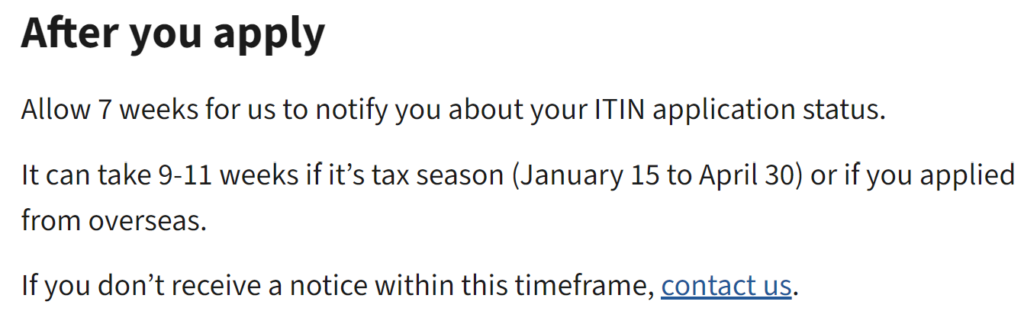
Anecdotally, we have found that the following time frames apply in most cases:
- During peak processing times (January to June), it usually takes 8-10 weeks for an applicant to receive their ITIN.
- Outside peak processing times (July to Dec), it usually takes 6-8 weeks for an applicant to receive their ITIN.
That said, in some cases, we have seen as long as 14 weeks for turnaround (even 16 weeks in the wake of COVID-19 pandemic).
Try not to be anxious if there is a delay – the IRS has to respond and return your documents, and one of the three possible notices (CP565/566/567).
It is possible to apply for an ITIN number at any time during the year. However, if you file a 1040 NR tax return along with the ITIN application (most cases), then you can incur late fees and interest charges when filing past the tax deadline of April 15.
The late fees and interest charges accrue according to Topic no. 653. You can use this IRS penalty calculator to forecast potential penalties you could incur. In general, the fees and interest will reach a maximum of 100% of the tax owed. So if you owe $10 USD in taxes, the most you can possibly owe is $20 USD.
Yes, you can. The IRS publishes the current month that is being processed for paper forms, including Form 1040 and Form W-7. You can view the status here, at the bottom of the page under “Other forms”.
You can also call to inquire directly about your application’s status. However, the IRS encourages individuals awaiting their ITIN confirmation to wait for 7 weeks before making inquiries if they applied during the tax filing season, or 9 to 11 weeks if the application was sent with a tax return during peak times.
The IRS can be reached from outside the US at 267-941-1000. Note that this is not a toll-free number. We recommend using a VoIP service (Google Voice, Textnow, Paygo, Tello, etc) to make the call, especially if you don’t have a good long-distance phone plan.
If that doesn’t work, you can also try calling the +1 800-908-9982 number. Press 1 for English, then 3 for ‘Other Inquiries’. Option 2 (obtain the status of your ITIN) seems to produce a ‘call us later’ prompt (YMMV).
Anecdotally, the best time to call is around late afternoon on the West coast (or in the evening on the East coast).
You can get a copy of your ITIN number once it’s been processed. To obtain a copy, you need to:
- Call the IRS: Contact the IRS at 1-800-908-9982 and request a copy.
- Verify Your Identity: Be prepared to verify your identity by providing personal information.
- Receive by Mail: The IRS will mail a copy of your ITIN number to your address on record.
Note that if you recently filed a Form W-7 and are successful, the IRS will mail you a letter containing the ITIN number, called CP 565.
You can use Form 8822 to notify the IRS of a change to your home mailing address. You can also just change your address when you file your next tax return, or submit written or oral statements of your address change as noted in the table below.
| Method | Action |
|---|---|
| IRS form | Use Form 8822, Change of Address or Form 8822-B, Change of Address or Responsible Party – Business |
| Tax return | Use your new address when you file |
| Written statement | Send us a signed written statement with your:
Mail your signed statement to the address where you filed your last return. |
| Oral notification | Tell us in person or by telephone. We’ll need you to verify your identity and the address we have on file for you. Please have ready your:
We may request additional information to verify your identity. |
I would recommend sending your address change form or written statement to both the ITIN program office and the regular IRS processing center to update the address on file for all tax purposes.
Also note that it may take four to six weeks from the date of receipt for the IRS to update their records.
If your legal name changes due to marriage, divorce, or another reason, you should notify the IRS so its records can be updated. You will generally need to provide documentation supporting the change, such as a marriage certificate, divorce decree, or court order. If you are renewing your ITIN, include the supporting documentation with Form W-7. Your ITIN number itself will not change.
If your mailing address changes while your ITIN application is being processed, you should notify the IRS as soon as possible to avoid missing important correspondence or your ITIN assignment letter (CP565). You can submit Form 8822 (Change of Address) or provide a signed written request containing your identifying information and old and new addresses to the IRS ITIN Operation. Keep in mind that changes may not be processed before the IRS sends correspondence to your previous address.
ITIN Expiration & Renewal
Yes, ITIN numbers expire after a specific time and require renewal. When a taxpayer’s ITIN number expires and isn’t renewed before submitting their tax return for the next year, they may encounter delays and even lose their qualification for some tax credits.
Read more: ITIN Renewal – Everything You Need to Know
Not necessarily. An ITIN generally expires if it has not been used on a U.S. federal tax return for three consecutive tax years. However, you only need to renew an expired ITIN if you intend to include it on a U.S. federal tax return. If you use your ITIN solely for banking, financial accounts, or information returns such as Form 1099, renewal is generally unnecessary for IRS tax-filing purposes. Individual financial institutions may have their own requirements.
Yes. When you renew an expired ITIN, the IRS reactivates your existing number rather than assigning a new one. Your ITIN remains associated with you, so you generally won’t need to update financial institutions simply because you renewed it.
Yes, in certain circumstances. The IRS allows qualifying family members to renew their ITINs together when a family member needs to renew. Each applicant must complete a separate Form W-7 and provide the required supporting documentation. Additional eligibility requirements apply to spouses and dependents, particularly when claiming allowable tax benefits.
You may encounter an e-filing rejection if your ITIN has expired. The IRS can still process tax returns containing expired ITINs, but processing may be delayed, and certain tax credits may be disallowed until the ITIN is renewed. If you need to file a tax return using an expired ITIN, you should arrange to renew it as part of the filing process.
Generally, an ITIN renewal must be submitted with a U.S. federal income tax return. If you are not filing a return and do not otherwise need your ITIN included on one, you generally do not need to renew it. Once you need to file a U.S. federal tax return again, you can renew your expired ITIN by submitting Form W-7 with the required tax return and supporting identification documents.
EIN FAQs
An Employer Identification Number (EIN) is a unique nine-digit number assigned by the Internal Revenue Service (IRS) to identify a business entity. Often referred to as a Federal Tax Identification Number, the EIN functions much like a Social Security Number for individuals, but for businesses. It is used for a range of purposes, from tax reporting to opening business bank accounts (and credit cards!).
Read more: Guide to Understanding the Employer Identification Number (EIN)
Applying for an EIN is a straightforward process, and it can be done online through the IRS website, by mail, fax, or telephone. To apply online, access the application tool on the IRS website here.
This is a common question. An ITIN (Individual Taxpayer Identification Number) is the number for use by U.S. non-citizens/non-residents to file their personal federal tax returns. An EIN (Employer Identification Number) is the number for use by U.S. businesses for their U.S. federal corporate tax returns.
Read our dedicated articles on each of these two numbers to learn more:
- Understanding the Individual Taxpayer Identification Number (ITIN): A Comprehensive Guide
- Understanding the Employer Identification Number (EIN): A Comprehensive Guide
You may require both ITIN and EIN numbers if you own a business in the U.S.
When you apply for an Employer Identification Number (EIN) by submitting Form SS-4 to the IRS, you’ll receive a confirmation notice called a CP-575 letter. This document officially confirms that the IRS has assigned your business an EIN. It includes your company’s legal name, address, EIN, and the date it was issued.
The IRS mails this letter to the address listed on your application. It typically arrives within 8 to 10 weeks after your EIN is issued. It can additionally be sent via fax if your application was submitted via a fax number.
It’s important to note that the CP-575 cannot be reissued if lost. If you need official proof of your EIN after the letter has been lost, you must request a 147C letter. This letter is only issued after the original EIN letter has been lost or never received. Similar to the CP-575, the 147C states your business name, your official EIN, your business address, and a statement confirming your EIN is active.
You can request the 147C letter by calling the IRS Business & Specialty Tax Line toll-free at 1-800-829-4933. If you are calling from outside the United States, instead, you can dial 267-941-1099. These lines are usually available between 7:00 AM and 7:00 PM EST. Be prepared to verify your identity and confirm you’re authorized to receive the document. Once verified, the IRS agent will ask you if you’d like to receive your 147C letter via physical mail or fax. Fax is immediate, while mail will take 4-6 weeks.
ITIN Genie FAQs
We have a 100% money-back guarantee for our ITIN service, but only if you use our combined ITIN + Document Verification (CAA) service. Our success rate with this method is 100% so we assure you we can get your ITIN issued.
If you use our ITIN Application service only, we do not accept responsibility for any potential user errors that could occur with mailing, document submission, and other factors. Learn more about our services here.
We accept credit or debit card payments via Stripe, and also via PayPal. We accept payments in Canadian dollars, but payments in other currencies will be accepted with conversion done by the payment processor chosen.
Yes. ITIN Genie is an IRS Certifying Acceptance Agent (CAA). We can apply for an Individual Taxpayer Identification Number (ITIN) for you and your family members and communicate with the IRS on your behalf. We can certify your passport or most other identity documents and thus you would not be required to send them to the IRS.
You can read more about our team and their credentials on the About page.
Yes, we certify passports from most other countries too, not just Canada. However, if you are unsure, feel free to send us an email to confirm your country is eligible. There are passports issued by certain countries that we may not certify.
We do not offer free consultations, whether online or in person. However, we are happy to answer pre-sale questions via email (hello@itingenie.com) or our contact form.
Yes, we provide customer support via email as needed. The amount of support that may be required depends on which of our services you choose.
We are also almost always happy to answer concise and pointed questions sent to our email, whether you’re already a customer or not.
We reside in Edmonton, Alberta, Canada. However, our virtual office and business address is located at 7103 Brent Ln, Lynden, WA, 98264.
We offer a remote service! In all cases, we need a clear copy of your original document(s) as well as video documentation of your document(s) with your face visible. We provide detailed instructions and guidance on how to complete these pieces once you complete our intake form.
We submit (by mail to the IRS) the complete application within 5 business days after it is received by us. We try our best to release the mail from our office twice a week. By default, we use the standard Canada Post mail service. If you want a faster mail service like Xpresspost, or a private courier service such as FedEx, we can do this but must invoice for the additional cost.
Frankly, the main delay in ITIN turnaround is due to the IRS processing time. IRS processing times are beyond our control and there is no priority service available for them. See ITIN FAQs above for more information regarding expected IRS processing times for ITIN applications.
Unfortunately, no. Your application must be reviewed and forwarded by our team. Rejections of applications are tracked by the IRS and we do not want to risk an incomplete or ineligible application forwarded by the client. You must submit the application to us.
We take the privacy and security of your personal information seriously. All personal information and documents submitted to ITIN Genie are handled securely and confidentially, with safeguards designed to protect your sensitive information throughout the ITIN application process. We are committed to protecting your privacy in accordance with applicable Canadian privacy laws, including the Personal Information Protection and Electronic Documents Act (PIPEDA).